Inflatable obstacle courses are one of the most popular commercial inflatables for party rental businesses, family entertainment centers, schools, community events, festivals, and outdoor attractions. They combine physical activity, competition, and entertainment in one product, making them a potentially valuable addition to a rental or amusement business.
But before purchasing one, buyers often ask:
How much does an inflatable obstacle course cost?
The short answer is: the price can range from around $1,500 for a small basic unit to more than $20,000 for a large, commercial-grade or highly customized obstacle course.
The final price depends on the size, design, materials, features, customization, accessories, and shipping requirements.
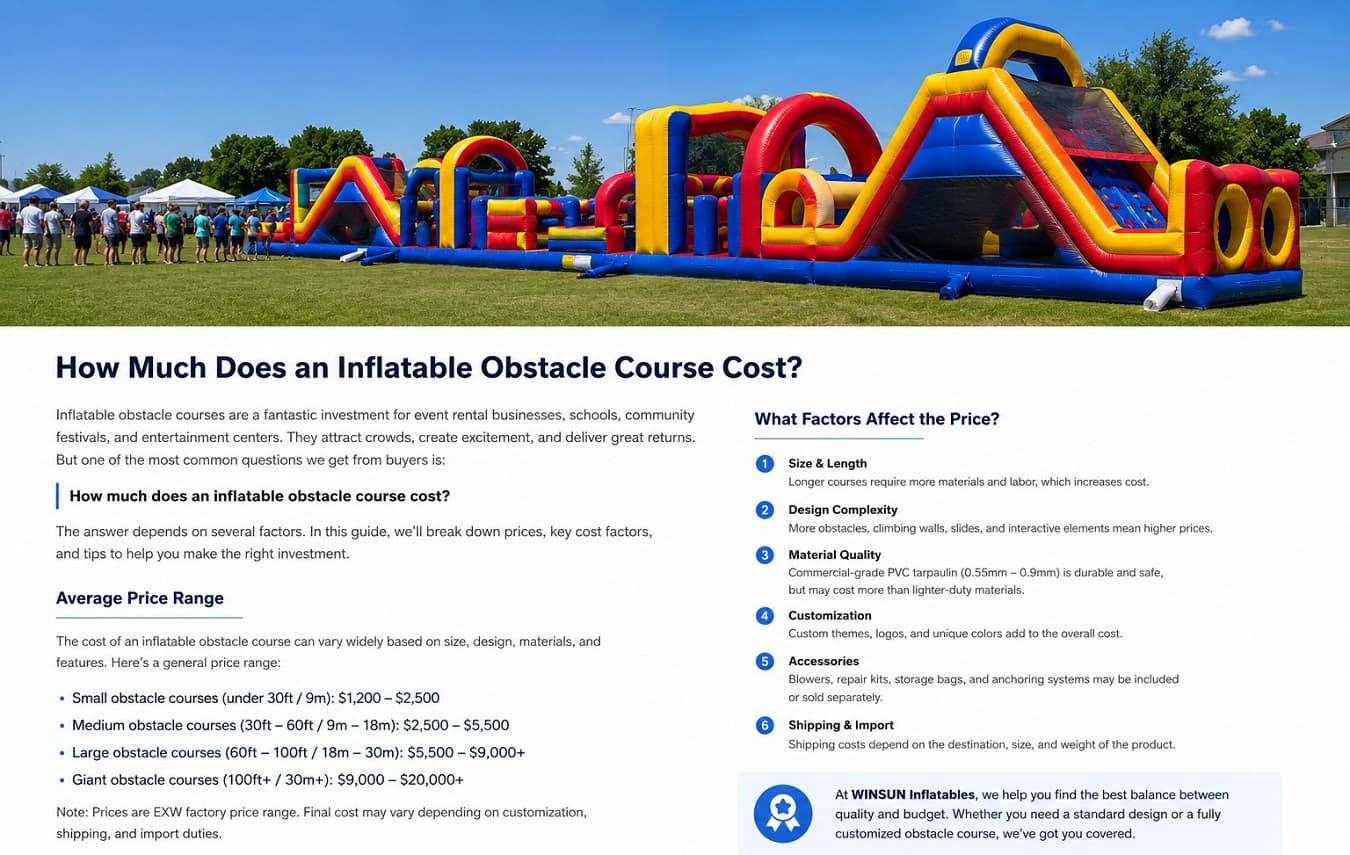
Average Inflatable Obstacle Course Price
There is no single standard price because inflatable obstacle courses can be designed in many different sizes and configurations.
As a general reference, commercial inflatable obstacle courses may fall into these approximate price ranges:
| Obstacle Course Type | Typical Size | Approximate Price Range* |
|---|---|---|
| Small obstacle course | Under 30 ft / 9 m | $1,500–$3,000 |
| Medium obstacle course | 30–60 ft / 9–18 m | $3,000–$6,000 |
| Large obstacle course | 60–100 ft / 18–30 m | $6,000–$10,000+ |
| Giant commercial obstacle course | 100+ ft / 30+ m | $10,000–$20,000+ |
| Custom multi-section course | Varies | $15,000–$30,000+ |
*These are general factory-price reference ranges. Actual prices vary according to specifications, materials, design, customization, quantity, shipping, and other requirements.
For a commercial buyer, it is important to compare what is included in the quotation, rather than comparing the product price alone.
What Determines the Cost of an Inflatable Obstacle Course?
Several factors have a direct impact on the final price.
1. Size and Length
Size is one of the biggest cost factors.
A 20-foot backyard obstacle course requires considerably less material, labor, packaging, and transportation than a 100-foot commercial obstacle course.
As the course becomes longer or wider, the manufacturer needs more PVC tarpaulin, reinforced connection points, stitching, internal structures, and production time.
For commercial applications, buyers should consider not only the purchase price but also how much usable space is available at the installation site.
2. Design and Number of Obstacles
A basic obstacle course may include tunnels, climbing sections, squeeze-through areas, and simple barriers.
More advanced designs can include:
• Climbing walls
• Slides
• Crawl-through tunnels
• Pop-up obstacles
• Bumpers
• Squeeze sections
• Vertical barriers
• Interactive elements
• Dual lanes for racing
• Multiple entrance and exit points
The more sections and functions included, the more complicated the manufacturing process becomes.
A simple straight obstacle course will generally cost less than a large multi-lane course with several interactive challenges.
3. Material Quality
Material selection has an important effect on both price and long-term performance.
For commercial inflatable products, PVC tarpaulin is widely used because it provides a good combination of strength, flexibility, waterproof performance, and durability.
WINSUN commonly uses commercial-grade PVC tarpaulin according to the product design and application. For example, continuous-inflation products can use approximately 0.55–0.6 mm PVC material, while sealed airtight products can use approximately 0.9 mm PVC material.
Material thickness is only one part of product quality. Buyers should also consider:
• PVC fabric quality
• Reinforced stress points
• Stitching quality
• Seam construction
• D-ring and anchoring reinforcement
• Internal structural design
• Protective mesh
• Overall workmanship
Choosing the cheapest material does not always mean achieving the lowest long-term cost.
4. Customization
Custom obstacle courses are usually more expensive than standard models.
Customization may include:
• Custom colors
• Company logos
• Brand graphics
• Custom themes
• Character designs
• Special obstacle configurations
• Custom dimensions
• Multiple lanes
• Unique entrance and exit designs
For rental companies and amusement operators, customized products can also provide branding opportunities and help create a more distinctive attraction.
5. Slides and Additional Features
Adding a slide or other major attraction can significantly change the product’s price.
For example, a basic obstacle course may focus primarily on crawling, climbing, and passing through obstacles. A more comprehensive combo unit could combine:
Obstacle Course + Climbing Wall + Slide + Interactive Game
Although such a product costs more initially, it can provide more activities within the same footprint and potentially increase its rental or attraction value.
6. Blowers and Accessories
The quotation should clearly specify which accessories are included.
Depending on the product, you may need:
• Commercial air blowers
• Ground anchors
• Repair kit
• Storage bag
• Carrying handles
• Safety ropes or additional anchoring equipment
When comparing quotations from different suppliers, make sure you compare equivalent configurations.
A lower product price may not represent a lower total purchase cost if important accessories are excluded.
7. Shipping and Delivery
Shipping is another important part of the total investment.
Inflatable obstacle courses can be large when packed, even though the inflatable itself is relatively lightweight compared with rigid amusement equipment.
Shipping costs depend on:
• Product dimensions after packing
• Gross weight
• Shipping method
• Destination
• Number of units
• Current freight rates
• Import duties and local fees
For international buyers, the landed cost should be considered rather than the factory price alone.
Commercial vs. Backyard Inflatable Obstacle Courses
One of the most important purchasing decisions is choosing the right product category.
Backyard Obstacle Courses
Backyard models are generally:
• Smaller
• More compact
• Easier to install
• Designed for family use
• Lower in purchase price
They are suitable for private homes, birthdays, family gatherings, and occasional recreational use.
Commercial Obstacle Courses
Commercial models are designed for more demanding applications such as:
• Party rental businesses
• Indoor amusement centers
• Family entertainment centers
• Schools
• Community events
• Festivals
• Resorts
• Adventure parks
Commercial products generally require more robust construction, stronger reinforcement, appropriate anchoring systems, and materials suitable for frequent use.
If the product will be used repeatedly for paid rentals, choosing a commercial-grade product is usually more appropriate than purchasing a residential model simply because it has a lower initial price.
How Much Should You Budget for a Rental Business?
For a new inflatable rental business, a practical starting point is to determine the target customer and available installation space before selecting the product.
For example:
Budget-conscious startup:
A smaller obstacle course in the $1,500–$3,000 range can provide an entry-level attraction.
Growing rental business:
A medium or larger commercial course in the $3,000–$10,000+ range can provide more capacity and a more substantial attraction.
Large entertainment operation:
A highly customized course costing $10,000–$20,000+ may be appropriate when the attraction is expected to handle larger crowds and become a major part of the entertainment offering.
The best choice is not necessarily the largest obstacle course. It is the product that provides the best balance between purchase cost, available space, customer demand, durability, transportation, and potential revenue.
What Should You Ask an Inflatable Manufacturer?
Before placing an order, ask the manufacturer for a complete quotation and product specification.
Important questions include:
1. What material is used?
2. What is the material thickness?
3. Is the product designed for commercial use?
4. What are the exact inflated dimensions?
5. What is the packed size and weight?
6. How many blowers are required?
7. Are blowers included?
8. What anchoring system is provided?
9. What certifications are available?
10. Is customization available?
11. What warranty is provided?
12. What is the production lead time?
13. What shipping options are available?
14. What exactly is included in the quoted price?
These questions can help you avoid comparing suppliers based only on the headline price.
Why Buying Directly From a Manufacturer Can Save Money
Working directly with an experienced inflatable manufacturer can reduce unnecessary intermediary costs and make customization easier.
At WINSUN, we manufacture inflatable amusement products for customers around the world and provide standard and customized solutions for different applications.
Our manufacturing capabilities include commercial inflatable obstacle courses, interactive games, bounce houses, slides, water attractions, inflatable parks, and other amusement products.
For commercial projects, we can work with customers on:
• Product design
• Size and configuration
• Material selection
• Custom graphics
• Branding
• Production
• Quality inspection
• Packaging
• International shipping
The goal is not simply to offer the cheapest inflatable obstacle course, but to provide a product that offers a practical balance of quality, durability, safety, appearance, and overall value.
Is an Inflatable Obstacle Course a Good Investment?
An inflatable obstacle course can be a strong addition to a rental or entertainment business because it combines multiple activities into one attraction.
A well-designed course can be used for:
• Birthday parties
• School events
• Corporate events
• Community festivals
• Church events
• Sports events
• Family entertainment
• Rental businesses
• Indoor play centers
The potential return depends on your local rental rates, utilization, operating costs, seasonality, transportation, maintenance, and marketing.
Before purchasing, estimate how many times you expect to rent or operate the product each month and compare that revenue potential with the total investment.
Final Thoughts
So, how much does an inflatable obstacle course cost?
A reasonable general range is approximately $1,500 to $20,000+, with smaller units at the lower end and large commercial or customized courses at the higher end.
The most important thing is to look beyond the initial price.
Consider the size, materials, construction, design, customization, accessories, shipping, warranty, and expected frequency of use before making a purchasing decision.
For a professional rental company or amusement operator, investing in the right commercial-grade inflatable can be much more valuable than simply choosing the cheapest option.
Looking for a commercial inflatable obstacle course for your business? Contact WINSUN for product recommendations, customized designs, and a factory quotation based on your requirements.
About WINSUN:
WINSUN is a premier integrated designer, manufacturer, and global exporter of high-end inflatable amusement equipment. With over 19 years of specialized experience serving the European and North American markets, the company offers a comprehensive range of products, including inflatable water parks, slides, bounce houses, obstacle courses, and large-scale custom themed attractions. Headquartered in Zhengzhou with manufacturing facilities in Pingdingshan and a dedicated U.S. office and warehouse, WINSUN is committed to delivering safe, innovative, and commercially successful entertainment solutions worldwide.
Media Contact:
Marketing Department
Email: Info@winsuninflatables.com
Website: www.winsuninflatables.com
Copyright © 2007-2026 HOP WINSUN Inflatables. all rights reserved Power by Power by Sinoart.